Story Stories
Stories about story, and about stories. A rotating selection of essays, blogs and observations.
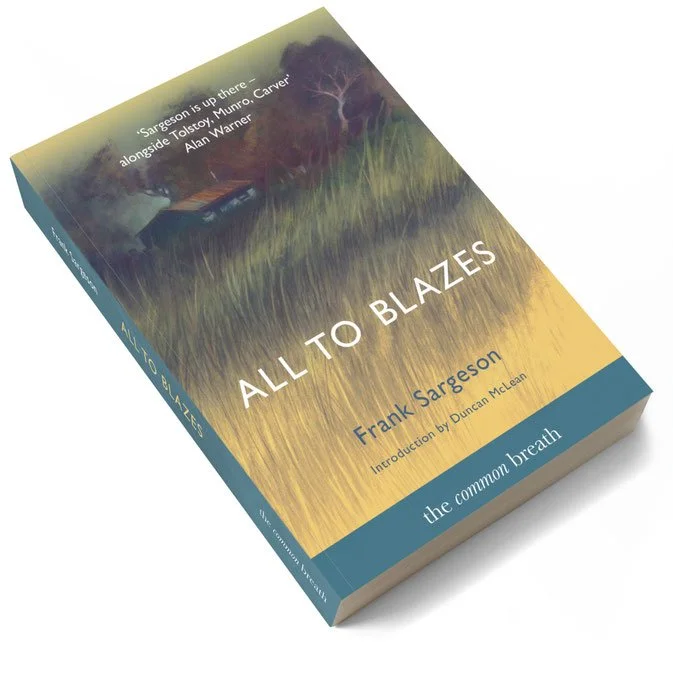
‘Nothing and Nobody’ is the introduction to All to Blazes: Selected Stories by Frank Sargeson, published by The Common Breath, Glasgow, in 2021. The book, co-edited with Brian Hamill, marked the culmination of several years of writing about Sargeson, including essays in thi wurd, London Review of Books, The Spinoff and in two Abersee Press booklets.
Sadly, Brian Hamill died a month after All to Blazes was published, just as he was starting to promote and distribute the book. The Common Breath folded, and remaining stock of the book is missing presumed lost.
Nothing and Nobody
New Zealanders are akin to the Scots in releasing the flames of our kraken tongues and burning away the habitations of English Literature. Frank Sargeson was a forerunner in creating New Zealand idiom and I follow in his footsteps, along with many others.
Witi Ihimaera
The first story in Frank Sargeson’s first book was called ‘Conversation with my Uncle’. The story gave the 1936 pamphlet its title. Four years later came a full-length collection, A Man and his Wife, which also included ‘Conversation with my Uncle’. A third book, That Summer and other stories (1946) again swallowed up the contents of its predecessor, and again has ‘Conversation’ as its opener. Several Collected Stories have been published since the early 60s, each placing ‘Conversation’ front and centre.
Why the prominence for a story that barely stretches to 500 words? Is it even a story? Sargeson himself called it a sketch, and it’s true there is no series of events in narrative form, no dialogue, despite its title. That title is easily misread. It’s not ‘A’ or ‘The’ ‘Conversation with my Uncle’, a record of one memorable exchange. No, it’s about conversation in general, about communication, about dialogue between one human being and another. A series of very similar sentences start successive paragraphs:
It’s difficult to have a conversation with my uncle.
It’s very difficult to have a talk with my uncle.
I’ve tried talking about lots of things with my uncle but it’s too difficult.
Once or twice I’ve tried talking to my uncle about risky subjects.
There are six paragraphs in the story, and the four central ones are concerned with language, and its power, and its limitations. It’s not that the uncle won’t converse: ‘He loves the sound of his own voice and he’s all the time waiting for you to finish so he can get going himself.’ Although, ‘It doesn’t interest him to listen to what you’ve got to say.’
Here’s the problem in trying to have ‘conversation with my uncle’. He doesn’t listen, he doesn’t reply, he doesn’t engage; he just talks. And that’s not conversation, that’s an abuse of power by a powerful man. (The uncle is ‘on the City Council and one of those boards, the sort you get paid for being on.’)
The prominence Sargeson gave to this very short story in successive collections underlines the importance to him of speech, and writing based on speech. It’s a profoundly egalitarian story, and Sargeson’s writing practice is profoundly egalitarian. His approach necessitates a genuine two-way interaction between writing and reading. There’s no ‘god voice’, no narrator possessed of all power and authority. There’s the text, and there’s the reader, and between the two the stories come to life.
What about Frank Sargeson’s life? Where was he born, when did he live, what is his story? As Witi Ihimaera’s quote at the top of this essay demonstrates, he is considered – by Māori and Pākehā alike – one of the pioneering figures of New Zealand literature. But no matter how many archives you search you won’t find a birth certificate for Frank Sargeson. That’s because, as well as inventing the New Zealand voice in fiction, he consciously and deliberately invented himself.
When I first came across the work of Sargeson in the early nineties, I had no idea there was any mystery about the man. But I did find some of his stories mysterious, or at least hard to understand. They seemed at first to be straightforward realistic accounts of life among labourers, farm-workers and struggling families. But nearly always a crack opened up in the narrative at some point, letting in doubt about the story’s meaning – even ambiguity about the basic facts of what was being recounted. Mrs Clegg in ‘That Summer’ has ‘a glass eye that that was cracked right down the middle, and it was funny the way she sort of looked out at you through the crack.’ A lot of Sargeson’s narrators have the same fractured vision. Take a story like ‘The Making of a New Zealander’, from 1939:
When I called at the farm they promised me a job for two months so I took it on, but it turned out to be tough going. The boss was all right, I didn’t mind him at all, and most days he’d just settle down by the fire and get busy with his crochet. It was real nice to see him looking happy and contented as he sat there with his ball of wool.
But this story is not about a cocky who used to sit in front of the fire and do crochet. I’m not saying I haven’t got a story about him, but I’ll have to be getting round to it another time.
Yes, the boss was alright, it was his missis that was the trouble. [But…] this isn’t just a no-account story about how I began to get cheeky and put wisecracks across Mrs Crump. It’s not about Mrs Crump, she only comes into it. I’m not saying I haven’t got a story about her too, but it’s another one I’ll be getting round to another time.
What I want to tell about is how I sat on a hillside one evening and talked to a man. That’s all, just a summer evening and a talk with a man on a hillside. Maybe there’s nothing in it and maybe there is.
Yes, the narration is conversational in tone. Yes, the crocheting farmer is unexpected and amusing. But the repeated discussion of what the story is and isn’t ‘about’ is genuinely puzzling. It underlines that this isn’t a simple straightforward realistic tale, but a piece of fiction well aware of its own complex relationship to the reality it’s constructing. It is, after all, about the ‘making’ of someone.
Back before the internet made it easy to track down obscure publications from the other side of the world, it was hard to find out much about Sargeson, let alone get hold of his books. But after a few years I came across this useful assessment by critic Eric McCormick, written in 1940:
Frank Sargeson’s [interest in the local] expresses itself in an attempt to mould the language and rhythm of everyday New Zealand speech – the speech of the street, the government office, the hotel bar, the middle-class household – into a literary form quite new in this country.[1]
Immediately I was reminded of one of the most famous declarations of intent in Scottish literature. Here’s James Leslie Mitchell, describing his own approach to narrative when writing under his own alternative identity:
The technique of Lewis Grassic Gibbon in his trilogy A Scots Quair […] is to mould the English language into the rhythms and cadences of Scots spoken speech, and to inject into the English vocabulary such minimum number of words from Braid Scots as that remodelling requires.[2]
Is this what Sargeson was all about? Such an understanding certainly helped me find a way into the stories, just as it had for many New Zealand readers in the 1930s, when Sargeson started to get published in radical newspapers like Tomorrow, general interest magazines like New Zealand Listener, and, slightly later, the literary journals like Landfall that were springing up as part of the ‘cultural nationalism’ movement. Recognition or publication outside the small local market was slow to come, but by the 1940s Sargeson was being featured extensively in James Laughlin’s New Directions in New York, and John Lehmann’s Penguin New Writing in London, amongst other high-profile publications.
Except for Katherine Mansfield 20 years earlier, no New Zealand writer had achieved such prominence. Mansfield moved from Wellington to London at the age of 19, and never came back, making personal contact with influential writers and publishers. Sargeson’s achievement was all the more remarkable in that he established himself internationally without ever meeting supporters like Laughlin, Lehmann and EM Forster.
As always seems to happen when someone chooses to write the way people actually talk, there was a hostile reaction to Sargeson’s work from many critics, academics and other (mainly older) writers. Journalist Pat Lawlor claimed Sargeson, ‘sneered and snarled and sobbed over an impossibly brutish concept of New Zealand life.’ John Cowrie Reid, later professor of English at Auckland University, wrote that Sargeson focussed too much ‘on violence, mental aberration, on the sordid, the cruel and the bitter.’ Elsie K Morton deserves credit for carving out a career as a reporter, unprecedented for a woman in New Zealand, but her understanding of the type of writing Sargeson was involved in was sorely lacking. ‘All NZ books should be impregnated with the good and the beautiful,’ she said in 1936, noting that, ‘the school of so-called realists drew their inspiration from sewers, prisons, madhouses and Soviet Russia.’
It’s hard to find any literary or artistic insight in this criticism; it’s purely political. And it’s a woefully inadequate response to the dozens of subtle and powerful stories Sargeson was publishing. Take ‘A Great Day’, for instance, a compressed, suggestive account of two friends spending a few hours on a fishing trip:
Except for some seagulls that walked on the sand and made broad arrow marks where they walked there wasn’t a single thing moving. It was so still it wasn’t natural. Except for the seagulls you’d have thought the world had died in the night.
Ken eased the dinghy off his shoulders and turned it the right way up, and Fred dropped the anchor and the oars on the sand, and heaved the sugar bag of gear into the dinghy.
I wouldn’t mind if I was a big hefty bloke like you, he said.
Well, Ken didn’t say anything to that. He sat on the stern of the dinghy and rolled himself a cigarette.
As the day goes on things get complicated: ‘I reckon our lines are crossed,’ says Fred at one point. And their fishing doesn’t go well: ‘They could bring nothing to the surface.’ But leaving aside the events of the day, there is much technical skill to take note of. The repetition of ‘walked’ in the first sentence. The collision of ‘it was’ and ‘it wasn’t’ in the second. The subtle shift to second person in the third sentence. In the second paragraph, there’s an easy but precise flow to the three-part narrative sentence with its complex assonances. Next, consider the distinctive NZ phrasing of Fred’s comment, and note the narrator’s beckoning, ‘Well…’ And lastly, see the tight restriction of the point of view, and the absence of quotation marks. It’s all very reminiscent of Grassic Gibbon, or for that matter James Kelman and a good number of recent Scottish writers. But above all it’s a masterclass in understated but highly charged narrative prose.
Apart from the interest of their language and approach to narrative, and of course the gripping events – no matter how small and domestic – they depict, the thing that struck me about almost all of Sargeson’s stories was their working class, overwhelmingly-male milieu. The characters are almost all Freds, Bills and Teds, and they are almost always quarrymen, farm labourers, dock workers and the like. The stories are of physical toil, economic hardship, and social relations under pressure, with the main source of support being camaraderie supplied by other men in similar situations.
It was when I read ‘That Summer’, a 60-page novella published in 1942, that I began to feel I was missing something about the fellowship shared by some of these cobbers, pals and mates.
During the depression, a young guy called Bill leaves a tedious farm job for the city, and once there hunts for lodging, work and entertainment. The last of these initially comes from ‘a bloke named Ted’:
He wasn’t a rangy specimen like me, no, he was nuggety, with one of those faces that is flat on the front of your head. And being dark he didn’t get sunburnt nearly as bad as I did. To kick off we’d fool about in the water, and if there was nobody around we wouldn’t worry about any togs. Then we’d fool about on the beach and lie in the sand.
It’s funny, I thought, here’s this macho writer Sargeson, with his laconic cobber characters, and what are they doing? Skinny dipping and ‘fooling around’ together. What did ‘fooling around’ mean in 1930s New Zealand? It can’t possibly be, I thought, but it’s almost as if Sargeson – the man in the street, the government office, the hotel bar – is depicting gay sex in uptight, puritanical pre-war New Zealand.
I must have misunderstood.
Shortly after, Bill becomes friends with Maggie, who lives in the same boarding house. After some flirtatious banter, mostly initiated by Maggie, they end up on her bed:
I told her to take it easy, and I put my arm round her and she cuddled up until I got my hand on her bubs. But so help me if she wasn’t that flat-chested I couldn’t even feel anything. […] Take it easy Maggie, I said. Struth, I said, but she was too keen. So I just lay back, I thought I’d let her work off steam a bit.
Okay, more gay sex. Fine. And a bit of crossdressing too. Excellent. But even more surprising for a writer of Sargeson’s blokeish reputation.
Bill’s longest and happiest relationship is with an older man called Terry, who eventually falls ill:
I’d look at him lying there.
Terry, I’d say.
What is it boy? he’d say.
Nothing, I’d say.
And then I’d say, Terry.
And instead of answering he’d just have a sort of faint grin on his face.
Terry, I’d say.
But I never could get any further than just saying Terry.
I wanted to say something, but I didn’t know what it was, and I couldn’t say it.
Terry, I’d say.
And he’d sort of grin. And sometimes I’d take his hand and hold it tight, and he’d let it stay in my hand, and there’d be the faint grin on his face.
Terry, I’d say.
I’m all right boy, he’d say.
In a column called ‘Using Words’ in the Auckland Star in 1937, Sargeson wrote:
Very often the simplest words will do. The method is largely one of suggestion and implication. You catch the suggestion best if it is put to you simply, and out of your own experience you can fill in all the complicated implications.
The simple words imply very clearly that the ‘something’ Bill is struggling to articulate is love. At the heart of ‘That Summer’ is a tender love story between two men.
From eleven thousand miles away, I’d imagined Sargeson as a Kiwi Gorky or Steinbeck, with a sprinkling of Modernist playfulness reminiscent of Sherwood Anderson or Gertrude Stein. It turns out that was an inadequate reading, though one shared over decades by both supporters and detractors.
Sargeson feared exposure and disgrace. He was terrified that his adopted persona would be ripped from him, revealing the name he was born with in 1903, Norris Davey. The revelation of the name might have been embarrassing to him and his family – pillars of the bourgeois establishment in the small town of Hamilton, 75 miles south of Auckland – but it could also have been seriously damaging, as it would have risked exposing his conviction for homosexual activity in 1929.
While working as a clerk in Wellington, Norris Davey had a sexual encounter with Leonard Hollobon, a painter of tourist trinkets, as he had done with others in the active but covert homosexual scene of puritan New Zealand, where such activities were frequently prosecuted. A few weeks later Hollobon found himself being blackmailed by a seaman – perhaps of a character similar to the matelot Bert in ‘That Summer’ – and for reasons that are hard to understand now, reported the matter to the police. The seaman having sailed off, Hollobon gave the police the name of another recent sexual partner, Davey.
In court a month later, both Davey and Hollobon were found guilty, but their sentences differed greatly. Hollobon got five years hard labour; Davey, with the help of a lawyer paid for by his appalled parents, pled innocence, promised to go straight, and received a suspended sentence.
Following his conviction, Norris Davey gave up his job, moved to his bachelor uncle’s remote farm, and hid himself away there for nearly two years. In fact, Norris Davey stayed on that Okahukura farm forever: the 28-year-old man who eventually emerged was called Frank Sargeson, and was neither a clerk nor a farmer, but a writer. Publication was still some years off, after a concentrated, almost monastic period of study and practice. But from the moment he walked off the farm – a few books, a typewriter and £2 cash in a sugar sack over his shoulder – he never wavered from the course he’d set himself: to become a published writer of serious fiction, to make a living, however meagre, from that writing, and to inhabit his new identity, Frank Sargeson. To inhabit it so thoroughly that the threat of imprisonment, and the anguish of denying his own sexuality, would be erased along with all public trace of Norris Davey.
For years his work was read as a celebration of socially conservative males: inarticulate road-diggers and sheep-shearers, jokers who liked a handle or two of beer, who broke in the wild Kiwi bush, who dug holes in the ground and filled them up again. It was always said that he wrote from the world of these blokes, and in their language: it was a brusque macho language, from a brusque macho writer. Really it was a lot more complex than that, and so was Sargeson.
What emerges from a more careful reading of his stories, his five novellas and five novels, is the remarkable extent to which his central characters were gay, lesbian, bisexual, transvestite and above all happily non-binary – at a time when New Zealand was notoriously puritanical and illiberal. Macho he was not.
What also becomes clear is that Sargeson was never a naively realistic writer who occasionally strayed into Stein-like Modernism. From the start he was a radical experimentalist. ‘I have never been interested in just writing another book,’ he says, in what appears to be his only extant appearance on film.[3] ‘It has always got to be some sort of book that has never been in the world before.’ Brusque he was not.
In later life Sargeson wrote a three-volume autobiography, with the final installment – Never Enough! – coming out five years before his death in 1982. It includes a remarkable passage where he sums up his mature attitude to writing:
In effect I was saying to readers of every description this is what my imagination makes of the matter in hand, and you can take it just as you please or leave it. […] Let friends readers critics keep or catchup with me if they could. […] Nothing and nobody could stop me.
And nothing and nobody did stop him. On the contrary, he created something out of nothing – New Zealand literature – and he created a somebody out of a nobody – Frank Sargeson.
Most importantly he created some of the most powerful and subtle short stories ever committed to paper, the best of which lie before you now.
[1]Letters and Art in New Zealand, 1940.
[2]Scottish Scene, 1934. The wording of McCormick’s passage is so close to Mitchell’s that it’s hard to believe he did not have it in mind Could McCormick have encountered Scottish Scene? He was resident in England in the early 1930s, as the Dictionary of New Zealand Biography attests, and moving in literary circles: ‘McCormick neglected to make any arrangements for pursuing his studies before arriving in England and was fortunate to be accepted by Clare College, University of Cambridge. From this base he attended lectures by the young academics I. A. Richards, Mansfield Forbes, and F. R. and Q. D. Leavis, whose rigorous approach to literary criticism combated what they saw as the dilettantism of their elders. Forbes and the Leavises took a friendly interest in the young New Zealander, and it was F. R. Leavis who suggested he replace the Elizabethan manuscript he had intended to study by an extension of his work on New Zealand literature, ‘with greater emphasis placed on cultural and historical forces’. With an Indian fellow student, McCormick planned a literary journal which, after they abandoned the idea as too costly, was taken up by Leavis to become his famous mouthpiece, Scrutiny.’ The NZBD entry was written by Dennis McEldowney, another appreciator and supporter of Sargeson’s work. CK Stead told me that Sargeson had read and enjoyed Sunset Song.
[3]Perfectly Frank: The Life of a New Zealand Writer, writer/director Bruce Sheridan, 1998. www.nzonscreen.com